
Story Face Off. Me vs. ChatGPT
Mar 16, 2026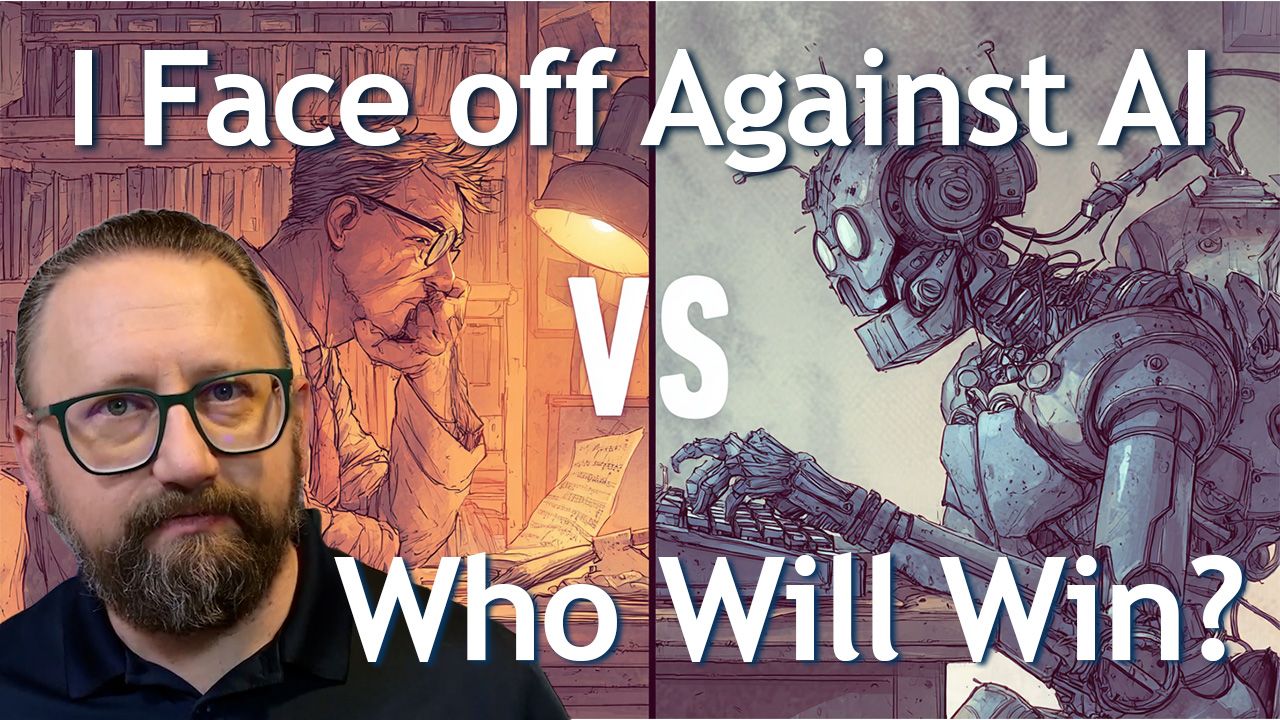
Here are the two stories from myself and ChatGPT. Please read them and let me know what your thoughts are.
Prompt:
Story Idea — Historical Western
A traveling photographer arrives in a dying frontier town and offers to take portraits of the remaining residents before they scatter. When the photographs are developed, each image contains a detail from the subject’s future—something that has not happened yet. The photographer must decide whether to reveal what the images show or leave the town to its fate.
Story 1
The image formed steadily before Ash’s eyes. He could see its development beneath the chemical mixture. Red light from the black room kept it from being completely clear, but he saw it just the same. Martha was her name. She leaned up against the late 60’s Mustang. He remembered seeing her and taking the picture just the day before. The car was beautiful and well-kept with only the day’s dust to indicate any imperfections. In the photograph, the car a crumpled wreck of metal and glass. Martha still leaned against it as though it were a normal car in its original state.
Ash double checked the photo. Once it had fully developed he lifted the paper from the solution and hung it carefully to dry. The paper was good, and he could find no issues with the developing process. The car in the picture was simply wrecked, and Martha still smiled as though her prized possession was tangle of metal and leaking fluids.
This was the first of the photos he had developed. He had spent the previous afternoon in the town of Riverfront Kansas. An unfortunate name for a town that saw the river dry up years before. He went to witness and record a modern-day diaspora in the middle of America. People had lived in the town for years and generations of families that had known Riverfront as home. Now, life was too difficult without the active water source.
He processed a picture of Raymond. Raymond was a man of seventy or so, and Ash wanted a picture of him standing in front of his two-story farmhouse. The house was surrounded by a collection of evergreen trees strategically planted to reduce the wind on the house. Ash remembered the pale-yellow house with white shutters and accents. Raymond had pointed out the stained-glass panes that he recovered from the town church after it had a fire many years before.
Ash remembered clearly taking this photograph, but as the solution brought the image to life, the house was simply gone. Raymond still stood in the photo, and the trees were still present and ready to absorb the wind, but the house was missing. Ash waited a moment to see if the image would eventually come through. He could clearly see the row of trees behind where the house had been.
He carried on like this for the entirety of the three rolls of pictures he had taken. He couldn’t be certain on some of the pictures, but for many he knew that the image was different than what he took. In some photos people were missing. In others, objects were missing or changed. He processed all of the pictures as quickly as he was able. He compared them to the negatives and even in the film the altered image was present.
Ash finished the last of the pictures, and as they dried, he collected his car keys and jacket. With the photos tucked haphazardly in a manila folder, he raced out the door and drove straight to Riverfront. It was two hours away from Wichita, and he needed to stop for gas along the way. He looked at each of the photos as he waited for his car to fill up. It had only been a day, but he remembered almost every picture differently than what the image shown.
His disregard for the speed limit and his willingness to pass cars earned him several angry honks and gestures along the way. He had a few hours of daylight remaining. Just before town several police officers were tending to a traffic accident. Ash slowed as he approached the scene. He was confused at first as there were two tow trucks. It appeared that one was a transport vehicle, and the other was there for the recovery of a now wrecked late 60’s Mustang.
Ash pulled up and stopped near an officer working the scene.
“What happened here?” Ash asked her.
“Seems that the transport truck didn’t secure the car properly. Once they got to speed, the car came loose and rolled a couple times on the highway.”
“Anyone hurt?”
“No, but I’m sure someone’s gonna be real mad when they see their car like this.”
Ash nodded. “Thank you.”
He carried on toward the town, but before going down Mainstreet, he turned to visit Raymond’s farm. Upon his approach, he found that the house was still intact and present like he remembered. He held up the photo against the real image of the home.
Raymond approached with another man as Ash got out of his car.
“Howdy!” Raymond called out. “Back for some more photos?”
“No, not exactly,” Ash said. “I think I forgot something, and I wanted to say hi.” He had left the photos on the passenger seat.
“Okay.” Raymond gestured to the man beside him. “This is Doug, he works for a company that’ll move your house whole and complete. You believe that?”
“You don’t say?” Ash offered.
“That’s right. My granddad built this house, and since the town ain’t got water anymore, were going to take it with us.”
Ash looked out over the house and the trees that buffered the wind. “So, this house will be gone from here in the future?”
“That’s right. Who’d of thought that if we looked into the future there’d be an empty space here where families used to work hard and break bread. And no one will know what had happened here.
Story 2
The photographer came into Red Hollow with the dust. Folks first noticed him as a silhouette moving along the road that cut across the prairie, the afternoon wind dragging pale sheets of dirt through the nearly empty street. The town had once been lively—wagons rolling through, children racing between storefronts, the sound of hammer and saw from the blacksmith’s yard. Now only a few dozen people remained, each quietly considering the same question: whether it was time to leave.
The man arrived leading a tired gray mule that pulled a narrow wagon. Painted on the side in fading letters were the words: A. Caldwell — Traveling Portraits. He stopped in front of the general store, climbed down slowly, and stretched the stiffness from his back. His coat was worn smooth at the elbows, and the brim of his hat showed the shape of many long miles.
The store door creaked open and Mrs. Barrow leaned out, squinting toward him.
“You selling something?” she asked.
“Memories,” Caldwell replied.
That earned a short laugh. “Town’s running out of those.”
He glanced down the quiet street before answering. “That’s exactly why I’m here.”
By the afternoon he had set up his camera near the town well. It was a heavy wooden box mounted on thin legs with a dark cloth hanging behind it. From his wagon he unloaded a folding chair and a crate of glass plates. People gathered slowly, drawn more by curiosity than by interest. News traveled quickly in a small place like Red Hollow, especially when something unusual appeared.
“Portraits,” Caldwell explained simply. “One dollar.”
Some shook their heads at the price, but a few lingered. People in dying towns often feel a strange urge to hold on to something before everything scatters.
The first to sit for the portrait was Samuel Pike, a restless seventeen‑year‑old who had already made up his mind to head west the moment he had enough money for a horse. Samuel sat stiffly in the chair while Caldwell adjusted the camera and lifted the cloth over his head.
“Hold still,” Caldwell said.
The camera clicked softly, capturing the moment. Samuel shrugged as he stood and wandered off again, already forgetting about the photograph.
Caldwell developed the plate inside the canvas darkroom built into the back of his wagon. A dim red lantern glowed over the trays of chemicals as he lifted the glass plate slowly from the bath. The image appeared clearly enough—Samuel seated in the chair, shoulders squared, face serious.
But something else stood in the image behind him.
Draped over the chair was a cavalry coat.
Caldwell stared at the plate for a long moment before carefully setting it aside.
More townsfolk came as the afternoon passed. Mrs. Barrow sat next, folding her hands patiently in her lap. When her plate developed, a sealed letter appeared resting against her dress, tied with a thin black ribbon. The blacksmith’s portrait revealed a grave marker standing beside him. A young woman who had only recently married appeared holding an infant that did not yet exist.
Each photograph held some small detail that had not yet come to pass.
By sunset most of the town had taken a turn before the camera. Caldwell carried the finished plates out to the square where the last light of day stretched across the prairie. The townspeople gathered quietly as he handed each person their portrait.
Samuel examined his first. Tilting the glass toward the fading light, he frowned.
“What’s that coat?” he asked.
“Looks like cavalry,” someone muttered.
Samuel said nothing more, but the thought lingered on his face.
Mrs. Barrow looked at her portrait next. When she noticed the ribbon on the letter, her expression softened into something thoughtful and distant.
One by one the people of Red Hollow studied their images. Some looked troubled. Others seemed strangely hopeful. Each plate showed a possibility—small glimpses of things that might still lie ahead.
Finally the blacksmith spoke. “You saying these things are going to happen?”
Caldwell leaned against the well, watching the wind sweep across the grass beyond town.
“I’m saying the photograph caught something,” he replied.
“What something?”
He considered the question for a moment before answering. “Maybe possibility.”
The crowd slowly dispersed. Some carried their plates carefully home. Others stood in the fading light a little longer, studying the images and thinking about what they might mean.
Late that night Caldwell packed his wagon. The mule shifted patiently in the darkness as he secured the camera and folded the legs of the chair. Before leaving, he walked once through the silent street. Lamps glowed behind a few windows where people were still awake, studying the small glass images of their possible futures.
When he climbed back onto the wagon, he reached into the crate and pulled out the final glass plate—his own portrait.
In the image he stood beside the wagon exactly as he did now. But behind him the town looked different. The street was busy again. Children ran through the dust, storefronts were open, and voices filled the air. A new sign hung above the general store.
Red Hollow was alive.
Caldwell studied the image for a long moment before setting it gently back into the crate. Then he flicked the reins and the mule stepped forward onto the dark prairie road. Behind him the town rested quietly beneath the night, each house holding someone who had seen a glimpse of tomorrow.
Check out the latest offerings from Writer's Theory
Stay connected with news and updates!
Join our mailing list to receive the latest news and updates from our team.
Don't worry, your information will not be shared.
We hate SPAM. We will never sell your information, for any reason.

